
Biosolids and PFAS

Biosolids and PFAS
Overview
Per- and polyfluoroalkyl substances (PFAS) are a large family of chemicals widely added to products that repel water, resist stains, prevent sticking, or last a long time. While valued for these properties, scientific studies have increasingly linked PFAS exposure to a variety of harmful health outcomes. These long-lasting chemicals enter wastewater systems through everyday product use.
Testing of Arlington County’s biosolids to date has shown low levels of common types of PFAS relative to industry benchmarks. So far, our low levels would qualify Arlington County’s biosolids for unrestricted use under a bill passed by the Virginia General Assembly during the 2026 legislative session (SB386 / HB1443).
Re-Gen does not include PFAS treatment because our concentrations have been low and technologies for PFAS removal and destruction in biosolids are still developing. However, Re-Gen will significantly reduce the volume of biosolids produced at the Water Pollution Control Plant (WPCP) by replacing aging equipment with state-of-the-art technologies. This improvement would likely help Arlington County adapt more quickly if PFAS treatment were needed in the future.
While state and federal regulatory guidance continues to develop, Arlington County is proactively taking these steps to manage PFAS throughout the wastewater system:
- Monitoring for PFAS in the Water Pollution Control Plant’s influent, effluent, and biosolids.
- Supporting research to improve understanding and treatment of PFAS.
- Tracking state and federal regulatory developments closely.
- Encouraging source control by educating customers about PFAS and PFAS-free products.
Reducing PFAS at their sources, before they enter the wastewater system, is one of the most effective ways people can protect themselves, public health, and local water resources.
Biosolids Basics
Biosolids are a nutrient-rich fertilizer made from organic materials recovered during the wastewater treatment process. By recycling nutrients into the soil, biosolids support healthy crops, enrich farmland, and keep valuable resources from going to waste.
The Water Pollution Control Plant currently produces Class B biosolids, which are stabilized for safe use on farmland. The Re-Gen project will treat Arlington County’s biosolids to the highest standards. The result, Class A biosolids, are safe, pathogen-free, and tested to meet strict quality requirements.
Class A Biosolids are:
- Versatile - Great for gardens, lawns, farms, and public spaces
- Eco-friendly - Improve soil health and cut landfill waste
- Energy smart - Produce renewable biogas during treatment
- Local benefit - Reduce odor and decrease truck traffic at the plant
- Safe - Meet all federal and state quality standards
 Biosolids 101
PFAS in Wastewater Systems
Wastewater utilities across the country are studying PFAS in their wastewater and biosolids. These long-lasting chemicals enter wastewater systems through everyday product use. Common examples of products that contain PFAS include:
- Stain-guard treatments for carpets and fabrics.
- Grease- and stick-resistant takeout containers and food wrappers.
- Non-stick cookware.
- Long-lasting cosmetics.
- Durable waxes, paints, and finishes for everything from walls and floors to sporting equipment and fingernails.
When PFAS-containing products are used, washed, or disposed of, these chemicals can be washed or flushed down drains and enter Arlington County’s wastewater system. That is why PFAS can show up in wastewater effluent and biosolids even though utilities do not use or produce these chemicals.
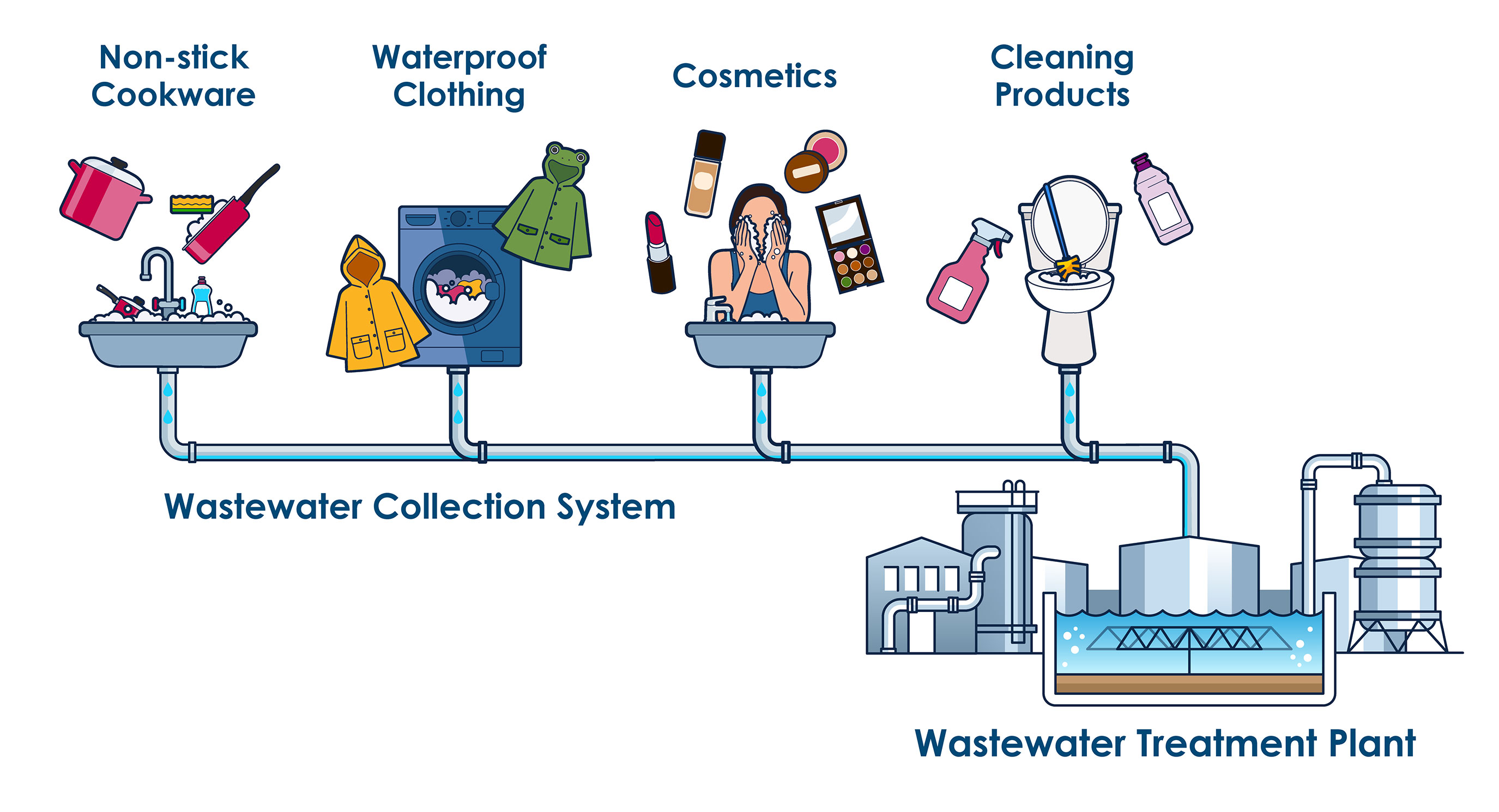
Switching to PFAS-free products in our homes and workplaces is a great way for individuals to reduce their own exposure and keep these long-lasting chemicals out of our water resources.
Re-Gen and PFAS Management
Re-Gen will significantly reduce the volume of biosolids produced at the WPCP by replacing aging equipment with state-of-the-art technologies. The volume reduction would likely help Arlington County adapt more quickly if PFAS treatment were to become necessary in the future.
Re-Gen does not include PFAS treatment now because our concentrations have been low and technologies for PFAS removal and destruction in biosolids are still developing.
Beyond the Re-Gen program, Arlington County is proactively managing PFAS throughout the wastewater system. Data collection, participation in research, regulatory tracking, and customer education are key strategies in a holistic PFAS management approach.
Several thermal treatment technologies – such as pyrolysis, gasification, and supercritical water oxidation – have been shown to reduce PFAS concentrations in biosolids. However, a major knowledge gap remains regarding their fate. It is not clear whether the PFAS are destroyed, transformed into other fluorinated compounds, or displaced into air emissions, liquid effluents, or other treatment byproducts.
Although a limited number of thermal treatment facilities operate worldwide, these approaches are not yet considered technologically and economically ready for widespread, utility-scale use. In wastewater systems with relatively low PFAS concentrations like ours, concerns related to performance, cost, energy consumption, and the potential transfer PFAS to other waste streams highlight the need for continued research.
Did you know wastewater facilities recycle water, microorganisms, and solids within the plant to make the treatment process more efficient and stable? Arlington County and WSSC Water have teamed up to investigate whether targeting PFAS in these internal “recycle streams” could reduce PFAS levels in wastewater effluent and biosolids. Because treating effluent and biosolids directly is still too costly and inefficient to be viable, this creative solution could give utilities a pathway to PFAS reductions within the limitations of current technology.
Research summary: “Breaking the Forever PFAS Cycle: Recycle Stream Treatment to Reduce PFAS Loading to WRRF Influent and Biosolids”
The Regulatory Context
State
In 2026, the Virginia General Assembly passed two bills directing the Department of Environmental Quality (VDEQ) to address PFAS at the state level. These laws direct DEQ to develop PFAS monitoring programs for wastewater systems (HB 1443 for utilities and HB 938 for industries connected to public wastewater systems) and establish permit requirements related to PFAS in biosolid-based fertilizers used on farmland (HB 1443).
To date, our levels are well below the legislation’s 25 parts per billion threshold and would qualify Arlington County’s biosolids for unrestricted use. The current land-application best practices in our existing permit further protect the region’s people, soil, and water resources.
Federal
PFAS are not regulated in biosolids at the federal level, but efforts to establish the scientific foundations for use in future regulatory assessments have begun.
In 2025, the U.S. Environmental Protection Agency (EPA) released a draft risk assessment for PFAS in sewage solids, the less-stabilized precursor to biosolids. A risk assessment is an early step in the federal rulemaking process. Its purpose is to evaluate what is currently known about the health risks posed by an unregulated substance. The findings establish scientific foundations that can inform future regulatory decisions, including whether limits or other controls on a substance may be warranted.
The 2025 draft risk assessment relied on modeling assumptions and methodological choices that generated over 25,000 public comments.
In response to the comments, EPA released draft guidance on managing risks associated with PFOA and PFOS in biosolids. PFOA and PFOS are two of the most studied PFAS compounds and are often used as indicators when evaluating potential PFAS-related risks. The new guidance provided needed context for how risk should be understood, communicated, and managed going forward. The agency suggests an incremental approach that relies on data collection, stakeholder input, and state-led initiatives to inform future decisions. EPA is accepting comments on this draft guidance through October 5, 2026.
Together, these federal and state efforts reflect an evolving regulatory landscape. The Re-Gen project alongside monitoring and Arlington County’s current biosolids land application practices position us well to continue meeting anticipated requirements.
Resources
- Biosolids 101 (Arlington County)
- PFAS in Biosolids (National Association of Clean Water Agencies)
- Draft Guidance for Reducing Risk from Perfluorooctanoic Acid (PFOA) and Perfluorooctane Sulfonic Acid (PFOS) in Biosolids (U.S. Environmental Protection Agency)
- PFAS and Your Health (Agency for Toxic Substances and Disease Registry)
- The PFAS Guide (ChemSec)